Few minerals have changed Nigeria’s mining story as quickly as lithium. Within three years, lithium-bearing pegmatites that were once worked mostly by hand have attracted large processing investments, a presidential commissioning ceremony, and a national policy designed to keep more of the value in Nigeria. For investors, lithium mining in Nigeria is shifting from an informal raw-ore trade towards an organised, processing-led industry, and that shift is where the opportunity lies.
Key takeaways
- Global lithium demand is driven by electric vehicles and energy storage. The International Energy Agency has projected demand could grow more than 40-fold by 2040 in a rapid-transition scenario.
- Nigeria’s lithium occurs in pegmatite belts across Nasarawa, Kogi, Kwara, Oyo, Ekiti, Cross River and the Federal Capital Territory.
- Processing capacity is arriving. A 6,000-tonne-per-day plant was commissioned in Nasarawa State in July 2026, and Chinese firms alone are reported to have invested around $1.3 billion in Nigerian lithium processing between 2023 and 2025.
- New mining titles must now include a local processing plan, which favours investors who build value-chain partnerships.
- Grade variability, artisanal legacies and title diligence mean verified data and structured partnerships are essential.
Why lithium matters globally
Lithium is the defining raw material of the battery economy. It is essential to the lithium-ion batteries that power electric vehicles, grid-scale energy storage, phones and laptops. In its landmark report on critical minerals, the International Energy Agency projected that lithium demand could rise more than 40 times by 2040 under a scenario consistent with global climate goals.
Lithium prices have been volatile, with sharp peaks and corrections. The long-term structural need for secure, diversified supply has not gone away, however. Governments and manufacturers in Europe, North America and Asia are actively seeking new sources outside today’s concentrated supply chains, and Africa is central to that search.
Where lithium is found in Nigeria
Nigeria’s lithium occurs mainly in pegmatites, coarse-grained igneous rocks that can host lithium minerals such as spodumene and lepidolite, often alongside tin, tantalum and gemstones. Pegmatite belts run across central and south-western Nigeria. The Nigerian Investment Promotion Commission identifies Nasarawa, Kogi and Cross River as key lithium states. Exploration companies have also mapped extensive pegmatite districts across Kwara, Oyo, Ekiti and the Federal Capital Territory, including one reported 600 km² area.
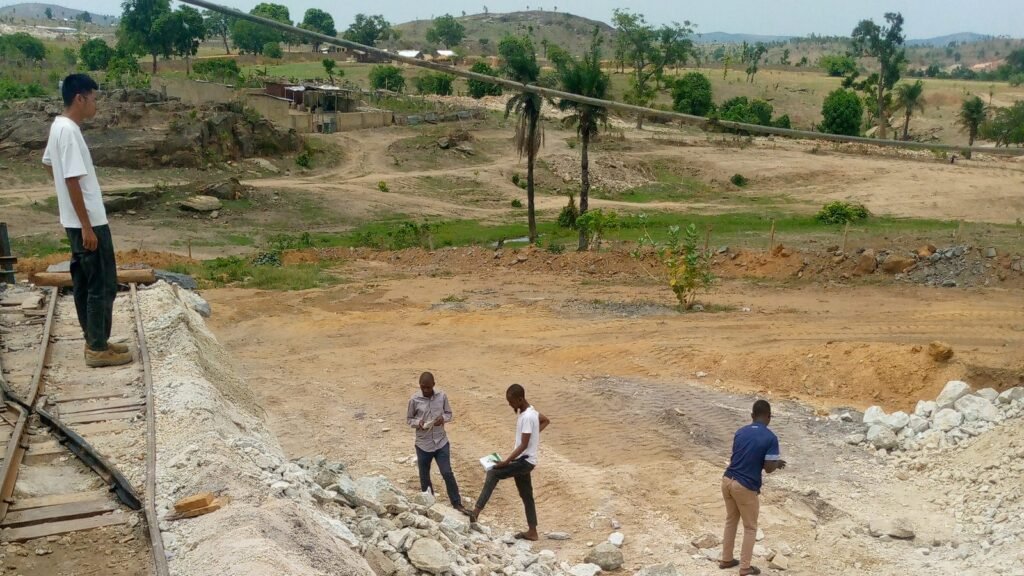
The photograph above shows lithium workings near Takushara village on the outskirts of Abuja, a reminder of how close some of these resources are to Nigeria’s capital and its transport links.
Read more about the mineral itself on our Lithium page, and about associated minerals such as columbite–tantalite and cassiterite.
The processing era has begun
Until recently, much Nigerian lithium left the country as unprocessed ore, often mined artisanally and sold through informal channels. That model created little local value and raised traceability concerns. It is now being replaced.
- Nasarawa, May 2024. Avatar New Energy Materials commissioned a lithium processing plant in Nasarawa State, one of the first of its kind in the country.
- Endo, Nasarawa, July 2026. President Bola Tinubu, represented by Vice President Kashim Shettima, commissioned Diamond New Energy’s lithium plant. It was built with around $250 million of investment and designed to process about 6,000 tonnes of lithium ore per day, close to 3 million tonnes a year. Reports describe it as West Africa’s largest lithium processing facility, with more than 1,000 direct jobs.
- Wider pipeline. Chinese companies are reported to have invested around $1.3 billion in Nigerian lithium processing between 2023 and 2025, with additional facilities in development.
The government’s ambition reaches further. At the Endo commissioning, the Minister of Solid Minerals Development said the goal is ultimately to produce lithium batteries, electric vehicles and mobile phones in Nigeria.
What the value-addition rule means for investors
Nigeria’s value-addition policy requires minerals to be processed locally before export, and the ministry has said it no longer issues new mining titles without a concrete local processing plan. For lithium investors, this has three practical consequences:
- Processing partnerships are central. A mining project without a credible route to processing, whether its own plant, a tolling arrangement or a supply agreement with an existing processor, will struggle to secure titles and approvals.
- Feedstock reliability has value. New plants need consistent, traceable and correctly specified ore. Well-organised mining operations that can supply to agreed specifications are in demand.
- Traceability matters to end buyers. International battery and automotive supply chains increasingly ask where minerals come from and how they were produced. Formal, documented supply chains are a commercial advantage.
Risks to manage
The opportunity is real, and so are the risks. Serious investors should plan for them from the start:
- Grade and deposit variability. Pegmatite deposits vary widely in lithium grade and size. Artisanal workings show that mineralisation exists, but they do not establish the resource. Systematic exploration, drilling and independent technical reporting are needed before major investment.
- Title and community diligence. Lithium has seen disputes over titles and site access. Mineral titles should be verified with the Mining Cadastre Office, and host-community agreements properly concluded.
- Price cycles. Lithium prices move in cycles. Project economics should be tested against conservative price assumptions.
- Fiscal changes. Royalty rates for several minerals, including lithium, were revised under the Nigeria Tax Act 2025, and collection moved to the Nigeria Revenue Service from January 2026. Current specialist tax advice is essential.
Ways to participate
Investors can approach Nigerian lithium in several ways, depending on their strategy:
- Exploration and development joint ventures with existing licence holders, combining local title and access with technical and financial capability.
- Supply and offtake arrangements for processed or concentrated material that meets agreed specifications.
- Processing and beneficiation partnerships that align with the value-addition policy.
- Technical and service partnerships covering laboratories, logistics, equipment and environmental management.
How CMR works with lithium investors
Confucius Mining Resources Ltd is an Abuja-based solid minerals mining and investment company. Through established relationships with licence holders, resource owners, technical specialists and strategic partners, CMR helps investors and commercial partners evaluate and structure lithium opportunities without having to manage many separate relationships on the ground.
Our focus is on responsible resource development. That means verified information, properly authorised partnerships, community participation and alignment with Nigeria’s processing priorities. We work with appropriate technical and processing partners to support agreed quality and specification requirements.
Interested in lithium in Nigeria? Discuss a lithium opportunity with CMR.
Frequently asked questions
Is there lithium in Nigeria?
Yes. Lithium occurs in pegmatite belts across several Nigerian states, including Nasarawa, Kogi, Kwara, Oyo, Ekiti, Cross River and the Federal Capital Territory. It is now one of the most actively developed minerals in the country.
Can I export raw lithium ore from Nigeria?
Nigerian policy requires local processing before export, and new mining titles must include a local processing plan. Investors should build processing into their plans from the outset.
How do foreign investors get involved in Nigerian lithium?
Most international investors work through a Nigerian-incorporated company, a joint venture with a licence holder, or supply and processing partnerships. Each route needs careful title, technical and community due diligence.
This article is for general information only and does not constitute investment, legal or tax advice. Figures are drawn from the sources below and were correct at the time of writing (October 2026). Investors should conduct their own due diligence and take independent professional advice.
Sources
- International Energy Agency: The Role of Critical Minerals in Clean Energy Transitions
- BusinessDay: Nigeria opens West Africa’s biggest lithium processing plant
- Channels Television: Lithium processing plant commissioned in Nasarawa
- Energy News Network: Nigeria lithium processing and the value-addition rule
- Aluko & Oyebode: Nigeria’s Critical Minerals Moment (2026)
- Nigerian Investment Promotion Commission: Mining sector
Nigerian lithium is shifting from an informal raw-ore trade to an organised, processing-led industry — and that shift is where the opportunity lies.
Interested in working with CMR?
Discuss a Lithium Opportunity